Air-Launched 5-Inch Rockets
5-Inch FFAR (Forward Firing Aircraft Rocket)
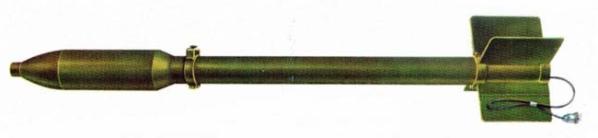
The first air-launched 5-inch rocket of the U.S. Navy was a derivative of an earlier 3.5-inch FFAR, which was developed by the Navy from June 1943 as an aircraft-launched ASW (Anti-Submarine Warfare) rocket. The 3.5-inch FFAR was considered accurate enough for use against surface ships and land targets, but needed a bigger explosive warhead for these missions. A 5-inch anti-aircraft shell was modified as a warhead for the 3.5-inch rocket motor. The resulting rocket was the 5-Inch FFAR, which entered service in December 1943. Because of the increased weight, the speed of the 5-inch FFAR was only 780 km/h (485 mph).
 |
| Image: via ORDATA Website |
| 5-Inch FFAR |
The complete 5-Inch FFAR round was designated 5.0" GP Aircraft Rocket MK 1, and consisted of the 3.25" Rocket Motor MK 7 and the 5.0" Rocket Head MK 1. Variants MK 1 MOD 0 through MK 1 MOD 5 used different types of nose and base fuzes. Training rounds were the 5.0" Practice Rocket MK 2 MOD 0 (with inert warhead, but live motor) and the fully inert 5.0" Dummy Rocket MK 3 MOD 0. An experimental development was the MK 37 round, with a 3.25" Rocket Motor MK 16 MOD 5/7/8. MK 37 MOD 0/1 used the MK 1 MOD 0 head, while the MK 37 MOD 2 had a MK 1 MOD 1 head with a proximity (a.k.a. VT) fuze.
The 5-inch FFAR was also used from LSM(R) (Medium Landing Ship, Rocket) type vessels as an interim 5-inch beach bombardment rocket before the better-suited spin-stabilized 5-Inch HVSR (High-Velocity Spinner Rocket) became available.
Holy Moses HVAR
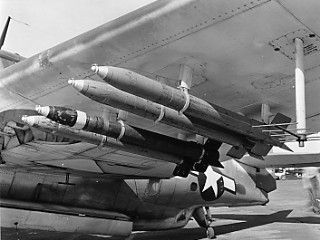
The 5-inch FFAR suffered from insufficient speed because of its small motor. Therefore the development of a larger rocket motor with 5-inch diameter was begun, and the first test firings occurred in December 1943. When fitted with the warhead of the 5-inch FFAR, the rocket achieved a velocity of 1530 km/h (950 mph), making it a very powerful weapon for its time. It was officially known as 5-Inch HVAR (High-Velocity Aircraft Rocket), but often called Holy Moses. It became operational in July 1944, and was used by Army Air Force and Navy aircraft.
 |
| Photo: U.S. Navy |
| Holy Moses |
During World War II, two versions of Holy Moses were built, one general-purpose (GP) with base and nose fuzes, and one with a semi-armour-piercing (AP) warhead and a nose fuze only. Postwar developments added a shaped-charge anti-tank warhead (HEAT), and a new general purpose type with a proximity fuze (a.k.a. VT fuze). More than one million Holy Moses HVARs were built until production ended in 1955.
The following table lists the 5.0" Rocket MARK/MOD designations for complete HVAR rounds:
| Designation | Type | 5.0" Motor | 5.0" Head |
|---|---|---|---|
| MK 4 MOD 0 | GP | MK 1 MOD 0, MK 2 MOD 0/2/3 | MK 5 MOD 0/1, MK 6 MOD 0/1 |
| MK 5 MOD 0 | Practice | MK 2 MOD 3 | MK 6 MOD 1 (inert) |
| MK 6 MOD 0 | Dummy | MK 2 MOD 3 (inert) | MK 6 MOD 1 (inert) |
| MK 20 MOD 0 | Smoke | MK 2 | MK 4 MOD 0 |
| MK 23 MOD 0 | AP | MK 2 MOD 3 | MK 2 MOD 1 |
| MK 23 MOD 1 | AP | MK 2 MOD 4 | MK 2 MOD 1/2 |
| MK 26 MOD 0 | GP | MK 2 MOD 4 | MK 6 MOD 1 |
| MK 28 MOD 0 | GP | MK 10 MOD 0 | MK 6 MOD 1 |
| MK 28 MOD 1 | GP | MK 10 MOD 1 | MK 6 MOD 1 |
| MK 28 MOD 2 | GP | MK 10 MOD 2 | MK 6 MOD 1 |
| MK 28 MOD 3 | GP | MK 10 MOD 3 | MK 6 MOD 1 |
| MK 28 MOD 4 | GP | MK 10 MOD 6 | MK 6 MOD 1 |
| MK 28 MOD 5 | VT | MK 10 MOD 6 | MK 6 MOD 4 |
| MK 29 MOD 0 | Practice | MK 11 MOD 0 | MK 23 MOD 0 (inert) |
| MK 31 MOD 0 | Dummy | MK 11 MOD 0 (inert) | MK 23 MOD 0 (inert) |
| MK 32 MOD 0 | HEAT | MK 10 MOD 6 | MK 25 MOD 0 |
| MK 32 MOD 1 | HEAT | MK 10 MOD 6 | MK 25 MOD 1/2 |
| MK 33 MOD 0 | Practice | MK 12 MOD 0 | MK 24 MOD 0 (inert) |
| MK 34 MOD 0 | AP | MK 10 MOD 6 | MK 29 MOD 0 |
| MK 35 MOD 0 | AP | MK 10 MOD 6 | MK 2 MOD 2 |
| MK 36 MOD 0 | Smoke WP | MK 10 MOD 6 | MK 4 MOD 1 |
| MK 38 MOD 0 | Flare | MK 10 MOD 6 | MK 26 MOD 0 |
| MK 39 MOD 0 | Practice | MK 10 MOD 6 | MK 6 MOD 1 (inert) |
MK 16 Zuni FFAR (Folding-Fin Aircraft Rocket)
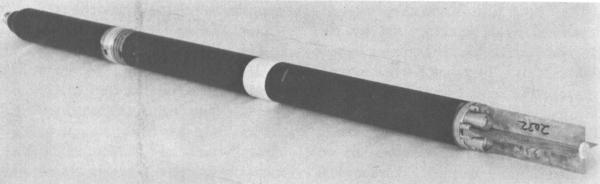
In the early 1950s, the NOTS (Naval Ordnance Test Station) China Lake began to develop a new 5-inch rocket to replace the Holy Moses HVAR. The new rocket used folding fins to allow efficient carriage in streamlined multi-tube launch pods. The rocket, known as Zuni 5-inch FFAR (Folding-Fin Aircraft Rocket), was designed as a modular system, and allowed the use of different types of warhead and fuze. Options included general-purpose and shaped-charged warheads, point-detonation, delayed-action and proximity fuzes. The latter option was intended for air-to-air application, but Zuni was almost exclusively used as an air-to-ground weapon. For a list of current warheads, see section on the MK 71 motor below. The Zuni FFAR was approved for production in 1957 and quickly replaced the earlier HVARs. Although a number of different launchers were tested with Zuni, the rocket was eventually deployed primarily in four-tube pods of the LAU-10/A series. The exact length and weight of the Zuni depends on the warhead, but typical values are 2.79 m (110 in) and 48.5 kg (107 lb), respectively.
 |
| Photo: via Ordway/Wakeford |
| Zuni MK 16 |
Complete Zuni rounds were initially designated with the following 5.0" Rocket MARK/MOD numbers, for two different types of warhead (High Explosive (HE) and Anti-Tank/Anti-Personnel (ATAP)) and fuzing (General Purpose (GP) and Proximity (VT)).
| Designation | Warhead Type | Fuzing Type | 5.0" Motor | 5.0" Head |
|---|---|---|---|---|
| MK 40 MOD 0 | HE | GP | MK 16 MOD 1 | MK 24 MOD 0 |
| MK 40 MOD 1 | HE | VT | MK 16 MOD 1 | MK 24 MOD 0 |
| MK 41 MOD 0 | ATAP | GP | MK 16 MOD 1 | MK 32 MOD 0 |
| MK 41 MOD 1 | ATAP | VT | MK 16 MOD 1 | MK 32 MOD 0 |
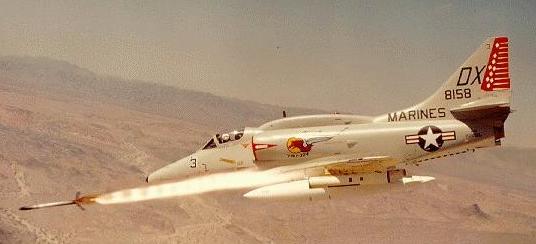
However, the practice of allocating MARK/MOD designations to all-up rocket rounds was abandoned around 1960. From then on, the rockets were characterized by the designation of the motor assembly, which is the main body of the rocket and includes nozzle and fins. The original production Zuni motor was designated MK 16, and the ultimate variant was the MK 16 MOD 3. The various warheads were typically usable with all available motors, and were presumably often fitted to the rockets in the field only briefly before actual use. Therefore it was apparently deemed unnecessary to assign MK/MOD designations to every specific combination of rocket and payload. In fact, the original edition of the current designation system for rockets and missiles explicitly excluded unguided line-of-sight rockets from the system.
 |
| Photo: McDonnell Douglas |
| Zuni MK 16 |
The Zuni was widely used by U.S. Navy and Marine Corps aircraft in Vietnam. However, the rocket was also the cause of the worst accident on a modern USN aircraft carrier, when a Zuni motor was inadvertently ignited on deck of USS Forrestal in July 1967.
MK 71 Zuni
Later 5-inch Zuni rockets used the MK 71 motor. It used a smoke-less propellant and had a completely new nozzle/fin assembly. The latter had four wrap-around type fins, and therefore the MK 71 was sometimes called a WAFAR (Wrap-Around Fin Aerial Rocket) instead of an FFAR. The actual diameter of the MK 71 is quoted as 130 mm (5.12 in). The MK 71 MOD 0 began to replace the MK 16 in June 1971, but was soon superseded by the MK 71 MOD 1, which entered full production in September 1973. The MK 71 MOD 1 was a HERO (Hazards of Electromagnetic Radiation to Ordnance) safe modification of the MOD 0. The MK 71 rockets were fired from LAU-10C/A and LAU-10D/A 4-tube pods, as the earlier launcher versions (through LAU-10B/A) were incompatible with the new motor. The LAU-10C/A was for shore-based use only, because it lacked the thermal protection coating of the -10D/A.
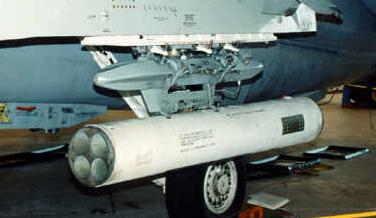 |
| Photo: U.S. Navy |
| LAU-10C/B or -10D/B (exact model unknown) |
A wide variety of warheads was available for the MK 71 rocket. The following table lists the basic characteristics (length, weight) of MK 71 Zuni rockets with the warhead/fuze combinations used by the U.S. Navy:
| Warhead | Warhead Type | Fuze | Length | Weight |
|---|---|---|---|---|
| MK 24 MOD 0/1 | General Purpose | MK 93 MOD 0 | 249.4 cm (98.18 in) | 56.8 kg (125.2 lb) |
| MK 188 MOD 0 | 240.0 cm (94.48 in) | |||
| MK 352 MOD 2 | ||||
| FMU-90/B | ||||
| MK 32 MOD 0 | Anti-Tank/Anti-Personnel | MK 93 MOD 0 | 277.9 cm (109.41 in) | 56.3 kg (124.13 lb) |
| MK 188 MOD 0 | 268.5 cm (105.71 in) | |||
| MK 352 MOD 2 | ||||
| FMU-90/B | ||||
| MK 33 MOD 1 | Illumination Flare | MK 193 MOD 0 | 274.6 cm (108.12 in) | 56.9 kg (125.4 lb) |
| MK 34 MOD 0 | Smoke (White Phosphorus) | MK 93 MOD 0 | 247.1 cm (97.28 in) | 58.2 kg (128.33 lb) |
| MK 188 MOD 0 | 237.7 cm (93.58 in) | |||
| MK 352 MOD 2 | ||||
| FMU-90/B | ||||
| MK 34 MOD 2 | Smoke (Red Phosphorus) | MK 188 MOD 0 | ||
| MK 352 MOD 2 | ||||
| MK 63 MOD 0 | Fragmentation | MK 93 MOD 0 | 287.5 cm (113.19 in) | 62.7 kg (138.3 lb) |
| MK 352 MOD 2 | 278.1 cm (109.49 in) | |||
| FMU-90/B | ||||
| MK 84 MOD 4 | Chaff/Countermeasures | FMU-136/B | 240.0 cm (94.48 in) | 56.8 kg (125.2 lb) |
| RR-182/AL | ||||
| MK 6 MOD 7 | Practice | n/a (nose plug) | 237.7 cm (93.58 in) | 58.2 kg (128.33 lb) |
| MK 24 MOD 0 | n/a (ogive) | 241.9 cm (95.25 in) | 58.0 kg (127.84 lb) | |
| WTU-11/B | inert MK 93 MOD 0 | 268.5 cm (105.71 in) | 56.3 kg (124.13 lb) |
In the early 2000s, the U.S. Navy gradually retired the Zuni rockets from active service. In 2023, the last 4000 Zunis in the U.S. stockpile were delivered to Ukraine, which used them against the invading Russian forces.
Specifications
Note: Data given by several sources show slight variations. Figures given below may therefore be inaccurate!
Data for 5-inch FFAR, 5-inch HVAR, Zuni MK 16, Zuni MK 71:
| 5" FFAR | 5" HVAR | Zuni MK 16 | Zuni MK 71 | |
|---|---|---|---|---|
| Length | 1.65 m (5 ft 5 in) | 1.83 m (6 ft) | 1.95 m (77 in) (motor only)* | 1.94 m (76.3 in) (motor only)* |
| Weight | 36 kg (80 lb) | 64 kg (140 lb) | 26.7 kg (58.9 lb) (motor only)* | 36.1 kg (79.5 lb) (motor only)* |
| Diameter | Warhead: 12.7 cm (5 in) Motor: 8.9 cm (3.5 in) | 12.7 cm (5 in) | 12.7 cm (5 in) | 13 cm (5.12 in) |
| Speed | 780 km/h (485 mph) | 1530 km/h (950 mph) | 2600 km/h (1615 mph) | |
| Range | < 1.6 km (1 mile) | 5 km (3 miles) | 8 km (5 miles) | |
| Propulsion | Caltech 3.5-in. rocket | Solid-fueled rocket | Solid-fueled rocket; 3.6 kN (800 lb) for 1.3 s | Solid-fueled rocket |
| Warhead | 20 kg (45 lb) HE warhead (& others) | (various) | ||
Main Sources
[1] Navy Training System Plan for the
Consolidated Rocket Systems (N88-NTSP-A-50-9801/A), August 2000
(formerly public, but access now restricted to authorized persons only)
[2] Norman Friedman: "World Naval Weapons Systems, 1997/98", Naval Institute Press, 1997
[3] Norman Friedman: "US Naval Weapons", Conway Maritime Press, 1983
[4] Norman J. Bowman: "The Handbook of Rockets and Guided Missiles", Perastadion Press, 1963
[5] Frederick I. Ordway III, Ronald C. Wakeford: "International Missile and Spacecraft Guide", McGraw-Hill, 1960
[6] Department of the Navy: "OP 1415: Rocket Assemblies, Complete Rounds and Components Data", 11 May 1955
[7] Department of the Navy: "OP 2210: Aircraft Rockets", 15 June 1960
Back to Directory of U.S. Military Rockets and Missiles, Appendix 4
Last Updated: 8 December 2025