5-Inch Bombardment Rockets (HVSR / BOMROC)
In May 1943, the Naval Bureau of Ordnance proposed the development of a new ship-to-shore rocket with a range of up to 9100 m (10000 yd). To be tactically useful, that rocket had to have a much lower dispersion than the short-ranged 4.5-Inch Beach Barrage Rocket. To fulfill such a requirement, the NDRC (National Defense Research Committee) recommended the development of a spin-stabilized instead of a fin-stabilized rocket. Other than air-launched rockets, which have significant forward velocity from the first moment of flight, surface-launched rockets start with zero airspeed, where fin-stabilization is ineffective. Furthermore, spin-stabilized rockets can be shorter and need no fins, making launchers with rapid automatic reloading capability much easier to design.
Development of spinner rockets began in mid-1943 at CalTech (California Institute of Technology). The first rocket was the 3.5-Inch GPSR (General Purpose Spinner Rocket), which was developed for the U.S. Marine Corps to replace the 75 mm pack howitzer. However the rocket's dispersion was too large, and it was therefore not adopted for service use.
Together with the 3.5-Inch GPSR, CalTech also developed a family of 5-inch spinner rockets, generally known as 5-Inch HVSR (High Velocity Spinner Rocket). Four versions of the HVSR with nominal ranges of 1140 m (1250 yd), 2290 m (2500 yd), 4570 m (5000 yd) and 9150 m (10000 yd) were designed. A variety of different warheads was developed for the 5-Inch HVSR, leading to the following rocket types:
- HCSR (High Capacity Spinner Rocket): medium shell thickness, maximum HE load
- GPSR (General Purpose Spinner Rocket): thick shell
- CnSR (Common Spinner Rocket): SAP (Semi-Armour Piercing) warhead
- SmSR (Smoke Spinner Rocket): thin shell, FS or WP (White Phosphorus) smoke
- CWSR (Chemical Warfare Spinner Rocket): thin shell, chemical agents
- PySR (Pyrotechnic Spinner Rocket): illuminating flare
The following table lists the 5.0" Rocket MARK/MOD designations for complete HVSR rounds:
| Designation | 5.0" Motor | 5.0" Head | Type; Remarks |
|---|---|---|---|
| MK 7 MOD 0 | MK 3 MOD 0/2 | MK 7 MOD 0 | GPSR; 10050 yd range |
| MK 7 MOD 1 | (Redesignated as MK 24 MOD 0) | ||
| MK 7 MOD 2 | MK 3 MOD 1/4 | MK 7 MOD 1/2/3 | GPSR; 9190 m (10050 yd) range |
| MK 7 MOD 3 | MK 3 MOD 1/4 | MK 7 MOD 1/2/3 | GPSR; 9190 m (10050 yd) range |
| MK 8 MOD 0 | MK 3 MOD 0/1/2/4 | MK 7 MOD 0/1/2/3 (inert) | Practice; for MK 7 training |
| MK 8 MOD 1 | MK 3 MOD 0/1/2/4 | MK 8 MOD 0/1/2 (inert) | Practice; for MK 24 training |
| MK 9 MOD 0 | MK 3 MOD 0/1/2/4 (inert) | MK 7 MOD 0/1/2/3 (inert) | Dummy; for MK 7 training |
| MK 9 MOD 1 | MK 3 MOD 0/1/2/4 (inert) | MK 8 MOD 0/1/2 (inert) | Dummy; for MK 24 training |
| MK 10 MOD 0 | MK 4 MOD 1/4 | MK 10 MOD 6/7/9 | HCSR; 4220 m (4620 yd) range |
| MK 10 MOD 1 | MK 4 MOD 1/4 | MK 10 MOD 9 | HCSR; 4220 m (4620 yd) range |
| MK 10 MOD 2 | MK 4 MOD 1/4 | MK 10 MOD 11 | HCSR; 4220 m (4620 yd) range |
| MK 10 MOD 3 | MK 4 MOD 1/4 | MK 10 MOD 12 | HCSR; 4220 m (4620 yd) range |
| MK 11 MOD 0 | MK 4 MOD 1/4 | MK 10 (inert) | Practice; for MK 10 training |
| MK 12 MOD 0 | MK 4 MOD 1/4 (inert) | MK 10 (inert) | Dummy; for MK 10 training |
| MK 13 MOD 0 | MK 5 MOD 1/4 | MK 12 MOD 0/3 | HCSR; 1960 m (2145 yd) range |
| MK 14 MOD 0 | MK 5 MOD 1/4 | MK 12 (inert) | Practice; for MK 13 training |
| MK 15 MOD 0 | MK 5 MOD 1/4 (inert) | MK 12 (inert) | Dummy; for MK 13 training |
| MK 16 MOD 0 | MK 6 MOD 1/4 | MK 13 MOD 0 | HCSR; 1350 m (1480 yd) range |
| MK 17 MOD 0 | MK 6 MOD 1/4 | MK 13 (inert) | Practice; for MK 16 training |
| MK 18 MOD 0 | MK 6 MOD 1/4 (inert) | MK 13 (inert) | Dummy; for MK 16 training |
| MK 19 MOD 0 | MK 4 MOD 1 | MK 14 MOD 0 | SmSR |
| MK 21 MOD 0 | MK 4 MOD 0 | MK 18 MOD 0 | PySR |
| MK 22 MOD 0 | MK 4 MOD 1 | MK 19 MOD 0 | PySR |
| MK 24 MOD 0 | MK 3 MOD 1/4 | MK 8 MOD 0/1 | CnSR; 8390 m (9180 yd) range |
| MK 24 MOD 1 | MK 3 MOD 1/4 | MK 8 MOD 2 | CnSR; 8390 m (9180 yd) range |
| MK 25 MOD 0 | MK 9 MOD 0 (inert) | MK 10 MOD 1 (inert) | Dummy; cycling test round for MK 102 launcher |
| MK 27 MOD 0 | MK 4 MOD 1/4 | MK 21 MOD 0/1 | SmSR; target rocket for gun fire practice |
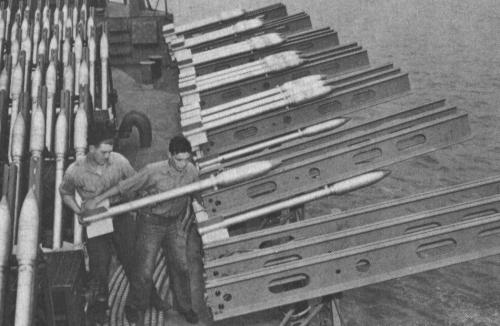
Sea trials of the HVSR eventually began in August 1944, and the first PT boats began to operate the rockets in spring 1945. In October 1944, the Navy had ordered the conversion of medium landing ships to rocket support ships (type LSMR) for the operations in the Pacific. Because the 5-Inch HVSR was not yet ready at the end of 1944, the first ships were equipped with launchers for fin-stabilized 5-Inch FFARs (Forward-Firing Aircraft Rockets).
 |
| Photo: via Ordway/Wakeford |
| 5-Inch FFAR (used as surface-to-surface rocket) |
Later LSMRs were equipped with the spinner rockets. Because of the more compact size, significantly more launchers could be carried which could also be reloaded much faster. Of the various HVSR variants, the most numerous, and the first one to see service, was the HCSR version. The rocket was extensively used during the landing operations at Iwo Jima and Okinawa, and was eventually also employed by LCI- and LCT-type landing craft. Development of launchers for the 5-inch spinner rocket eventually culminated in the MK 102, a two-barrel launcher which could be continuously loaded from below deck, and trained and operated by remote control.
 |
| Photo: via ORDATA Website |
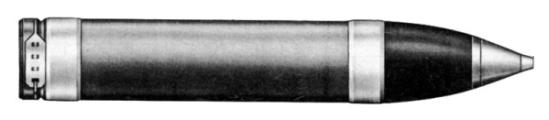
| 5-Inch GPSR |
CalTech and the Naval Ordnance Test Station (NOTS) unsuccessfully tried to develop air-launched derivatives of the 5-inch spinner rockets, known as CASR (Common Air-Fired Spinner Rocket), GASR (General-Purpose Air-Fired Spinner Rocket) and PASR (Pyrotechnic Air-Fired Spinner Rocket). In the first tests in late 1944, the rockets were completely unstable, and although the worst problems could be solved, the air-launched spinners were not better than the existing fin-stabilized aircraft rockets. Furthermore, the spinner rockets' bulky tube launchers were heavier and induced more drag than the simple posts which launched the finned rockets. The designations 5.0" Aircraft Rocket MK 30 MOD 0 and MK 30 MOD 1 were allocated to GASR test rounds with GP and VT fuzes, respectively.
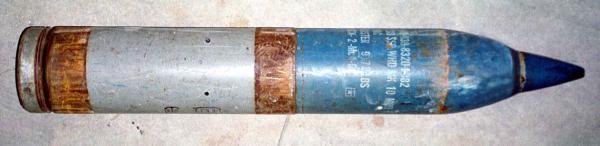
The 5-inch HVSR bombardment rockets were employed by the Navy through the 1950s and 1960s for landing operations and general coastal fire support. Later versions used improved rocket motors, and were generally referred to as BOMROC. They did not receive MARK/MOD designations for all-up rounds, but were characterized by their motor assemblies instead (MK 50 or MK 61). A typical BOMROC with a MK 50 motor and a MK 10 warhead was 74.9 cm (29.5 in) long and weighed 23.8 kg (52.5 lb). However, only a single new shore-bombardment ship was built after the war, the USS Carronade (IFS-1) in the early 1950s. It was a much larger ship than the original LSMRs, and its rockets were fired by MK 105 launchers, improved derivatives of the MK 102. In 1969, IFS-1 and the few remaining LSMRs were all redesignated in the new LFR (Amphibious Fire-Support, Rocket) category. Development of new rockets and launchers was discussed in the early 1970s, but eventually the LFRs, and with them the MK 102/105 launchers and BOMROC rockets, were phased out without a replacement. At that time, naval guns were regarded as adequate for ship-to-shore fire support.
 |
| Photo: via ORDATA Website |
| BOMROC 5-Inch Rocket |
Specifications
Note: Data given by several sources show slight variations. Figures given below may therefore be inaccurate!
Data for 5-Inch HCSR MK 10 MOD 0, 5-Inch GPSR MK 7 MOD 2, 5-Inch CnSR MK 24 MOD 1, BOMROC MK 50:
| 5" HCSR MK 10 MOD 0 | 5" GPSR MK 7 MOD 2 | 5" CnSR MK 24 MOD 1 | BOMROC MK 50 | |
|---|---|---|---|---|
| Length | 81.3 cm (32.0 in) | 80.0 cm (31.5 in) | 73.2 cm (28.8 in) | 74.9 cm (29.5 in) |
| Diameter | 12.7 cm (5 in) | |||
| Weight | 22.8 kg (50.3 lb) | 22.5 kg (49.6 lb) | 23.0 kg (50.8 lb) | 23.8 kg (52.5 lb) |
| Speed | 850 km/h (530 mph) | 1520 km/h (950 mph) | 1460 km/h (910 mph) | ? |
| Range | 4220 m (4620 yd) | 9190 m (10050 yd) | 8390 m (9180 yd) | ? |
| Propulsion | MK 4 5" solid-fueled rocket | MK 3 5" solid-fueled rocket | MK 50 solid-fueled rocket | |
| Warhead | MK 10 High explosive | MK 7 High explosive | MK 8 Armor-Piercing | MK 10 High Explosive |
Main Sources
[1] Norman Friedman: "US Naval Weapons", Conway Maritime Press, 1983
[2] Norman J. Bowman: "The Handbook of Rockets and Guided Missiles", Perastadion Press, 1963
[3] Frederick I. Ordway III, Ronald C. Wakeford: "International Missile and Spacecraft Guide", McGraw-Hill, 1960
[4] J.D. Gerrard-Gough, Albert B. Christman: "The Grand Experiment at Inyokern", Naval History Division, 1978
[5] ORDATA Online Website
[6] Department of the Navy: "OP 1260: Rocket Ammunition, 5.0" Surface Rocket Spin-Stabilized", 29 January 1951
[7] Department of the Navy: "OP 1415: Rocket Assemblies, Complete Rounds and Components Data", 11 May 1955
[8] Department of the Navy: "OP 2211: Surface Rockets", 18 November 1958
Back to Directory of U.S. Military Rockets and Missiles, Appendix 4
Last Updated: 9 December 2025