BAE Systems AGR-19 / AGR-20 / AGR-21 APKWS II
In 1996, the U.S. Army formulated a requirement for an APKWS (Advanced Precision Kill Weapon System) to close the gap in capability and cost between the unguided 2.75-Inch Hydra 70 rockets and the sophisticated AGM-114 Hellfire anti-armour guided missile. The Army needed a small and accurate weapon against non-hardened point targets especially in environments with a high risk of collateral damage, like e.g. in urban warfare. To fulfill the APKWS requirement, a guided development of the Hydra 70 rocket (also known as LCPK (Low Cost Precision Kill) 2.75-inch rocket) was selected. This missile would use the MK 66 motor with a new warhead/guidance section assembly, and would therefore be instantly compatible with all existing 70 mm rocket launchers in the U.S. inventory.
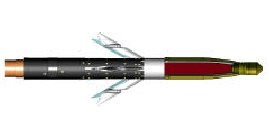
The initial variant of General Dynamics' APKWS was to use the M151 warhead combined with a low-cost semi-active laser seeker and small forward flip-out wings for flight control. The weapon was expected to have an accuracy of better than 1 m (3.3 ft) CEP.
 |
| Drawing: General Dynamics |
| APKWS M151 warhead |
It was initially planned to field APKWS in 2001/02, but significant delays due to lack of funding pushed this date further into the future several times. In September 2002, the APKWS program was redefined to cover the full range of MK 66 rockets, and therefore also included all unguided rockets of the Hydra 70 family. The first operational guided APKWS rocket was to be the M151 variant (also known as APKWS Block I), but the guidance section was expected to be compatible with the other warheads as well. However, the Army eventually cancelled the guided APKWS program in April 2005, because of poor test results.
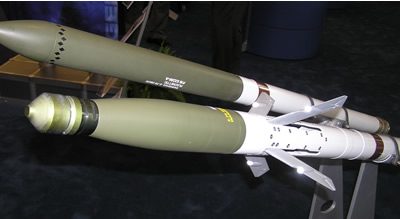
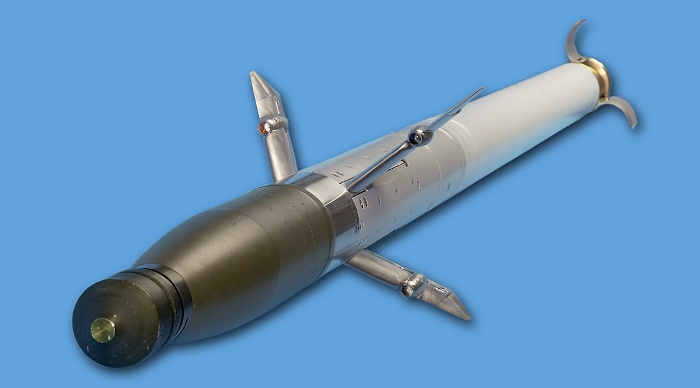
After the cancellation of APKWS, the competition was reopened under the label APKWS II. The only restriction was that the weapon must still be based on the Hydra 70/MK 66 rocket. Competitors in the APKWS II program were Lockheed Martin, Raytheon and a BAE Systems / Northrop Grumman / General Dynamics team. In April 2006, the BAE-led team was selected as winner by the U.S. Army, and received a 3-year contract for further development, testing, and initial production of the APKWS II missile. BAE's design is a laser-guided missile using a so-called Distributed Aperture Semi-Active Laser Seeker (DASALS) in a WGU-59()/B mid-body guidance section. Externally, it is similar to General Dynamics' original APKWS design. The WGU-59()/B is 47 cm (18.5 in) long, weighs 4.4 kg (9.8 lb) and its flip-out wings have a span of 24.3 cm (9.55 in).
 |
| Photo: BAE/General Dynamics |
| APKWS II |
APKWS II achieved IOC (Initial Operational Capability) with the USMC in 2012, and in the same year the first full-rate production contract was awarded to BAE Systems. The initial WGU-59/B version of the guidance section was suitable only for launch from helicopters, but BAE Systems has since developed the WGU-59A/B, which can also be used on fast fixed-wing aircraft. By 2020, APKWS II missiles had been successfully integrated with a wide range of platforms, including AH-1W/Z, AH-64 and MH-60 helicopters, and AV-8B, A-10, F-16 and F/A-18 jets. Because they are longer than unguided rockets, the APKWS II rounds require launchers with longer tubes. These include the LAU-68F/A and LAU-131A/A 7-tube launchers.
 |
| Image: BAE Systems |
| APKWS II |
Beginning in 2016, the U.S. military assigned MDS designations to some APKWS II all-up rounds:
| MDS | Warhead | Platform | Users |
|---|---|---|---|
| AGR-19A | MK 152 | Helicopter | USMC |
| AGR-19B | M282 | Helicopter | U.S. Army, USMC |
| AGR-20A | M151 | Fixed-Wing | USAF, USN |
| AGR-20B | M282 | Fixed-Wing | USAF, USN |
| AGR-20C | M151 | Helicopter | U.S. Army |
| AGR-20D | ? | ? | USN |
| AGR-20E | M285A2 | Fixed-Wing | USAF |
| AGR-20F | M151 | Fixed-Wing | USAF |
| AGR-21A | ? | ? | USAF |
| AGR-21B | ? | ? | USAF |
| AGR-21C | M151 | ? | U.S. Army |
The AGR-20F was developed by the USAF under the FALCO (Fixed-Wing, Air-Launched, Counter-UAS Ordnance) program, and is optimized for the air-to-air role against small and relatively slow unmanned aerial systems. It has a new TSC "VIPER" proximity fuze, and a WGU-59B/B guidance section with updated software (referred to as "True Pulse Logic Update"). In 2025, the AGR-20F has been successfully used in the Middle East against low-cost one-way attack drones. In the same year, BAE unveiled a dual-mode APKWS II missile, which has an additional IIR (Imaging Infrared) seeker to further improve the weapon's anti-air capabilities.
The designations JAGR-20A/B, ATR-20A/B amd ATR-21A have been allocated to test and training versions of the AGR-20A/B and AGR-21A, respectively.
Designation Note: The APKWS II rounds were designated in the R-sequence for unguided rockets, even though they are guided missiles and should therefore have received AGM designators. The likely reason is that the APKWS II missiles are generally referred to as guided rockets. On top of that, the AGR-20F is primarily an aerial intercept missile, which should be designated AIM.
Specifications
Note: Data given by several sources show slight variations. Figures given below may therefore be inaccurate!
Data for AGR-20F:
| Length | 187.5 cm (73.8 in) |
| Weight | 14.8 kg (32.6 lb) |
| Diameter | 70 mm (2.75 in) |
| Speed | 1000 m/s (3280 fps) |
| Range | > 12 km (7.5 miles) |
| Propulsion | MK 66 MOD 4 solid-fueled rocket; 6.7 kN (1500 lb) for 1.1 s |
| Warhead | M151 3.95 kg (8.7 lb) high-explosive |
Main Sources
[1] Various sources referenced in Wikipedia:
Advanced Precision Kill Weapon System
[2] NAVAIR: Advanced Precision Kill Weapon System
[3] DOD MDS Designation Records
Back to Current Designations Of U.S. Unmanned Military Aerospace Vehicles
Back to Directory of U.S. Military Rockets and Missiles
Last Updated: 12 December 2025