General Atomics X-68 LongShot
In 2021, DARPA started the LongShot program. The objective is to build and demonstrate a small air-launched UCAV with air-to-air capabilities, to significantly extend the air-to-air loadout and engagement range of the launching platform. Design contracts were given to General Atomics, Lockheed Martin and Northrop Grumman, and in September 2023, it was announced that GA was to build the LongShot demonstrator vehicles.
 |
| Image: General Atomics |
| X-68A |
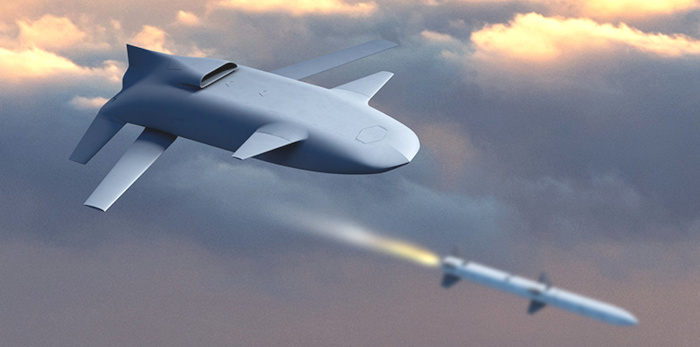
General Atomics' design is powered by a single Williams WJ38-15 turbojet. It has an inverted V-tail, canards, and forward-swept wings. Wings and canards are attached in a stowed position, and move into flying position shortly after the UCAV is released. LongShot has an internal weapons bay, most likely for at least two missiles with the form factor of the AIM-120 AMRAAM. The primary platform for LongShot deployment are fighters, but the vehicle could possibly also be deployed from bombers or even in "palletized" form from cargo holds of large transport aircraft. For test, evaluation and training, LongShot is designed to be recoverable. For operational missions this is not realistic, and the system is effectively regarded as expendable in an actual conflict.
In August 2025, DARPA designated the LongShot demonstrator as X-68A. Initially, it was planned for actual flight tests to begin in 2024. However, this schedule has since slipped, and at the time of this writing the first flight of an X-68A is expected later in 2026.
Specifications
No details about the characteristics of the X-68A are available.
Main Sources
[1] General Atomics ASI Press Release: GA-ASI Poised
to Begin LongShot Flight Testing Phase, 11 September 2023
[2] The War Zone, Joseph Trevithick:
LongShot Air-To-Air Combat Drone Bid Won By
General Atomics, September 2023
[3] The War Zone, Joseph Trevithick:
F-15 Depicted Launching
LongShot Air-To-Air Missile Carrier Drone In New Renderings, September 2025
[4] Department of Defense MDS nomenclature records
Back to Directory of U.S. Military Rockets and Missiles, Appendix 4
Last Updated: 3 February 2026