NASA SLS (Space Launch System)
The development of the SLS (Space Launch System) super-heavy expendable launch vehicle began in 2011, when the U.S. Congress mandated NASA to develop a replacement system for the soon-to-be-retired Space Shuttle and the the cancelled Ares program. NASA was to use existing components wherever possible. The first stage of the SLS rocket, built by Boeing and also called the Core stage, consists of a large structure containing the liquid oxygen and hydrogen tanks, and four Rocketdyne RS-25 (a.k.a. SSME, Space Shuttle Main Engine) engines. The first four SLS Core stages use remaining RS-25D engines from the Space Shuttle program, while later ones will be equipped with new-built RS-25E engines, optimized for expendable use. Attached to the Core stage are two large solid rocket boosters (SRBs), derived from the the Space Shuttle SRBs and manufactured by Northrop Grumman. The SLS second stage, built by United Launch Alliance and called ICPS (Interim Cryogenic Propulsion Stage), is a minimally modified derivative of the DCSS (Delta Cryogenic Second Stage), the upper stage of the Delta 4 rocket. It is powered by a single Rocketdyne RL10B-2 engine.
| Stage | Length | Diameter | Engine(s) | Fuel | Thrust |
|---|---|---|---|---|---|
| 0 | 54 m | 3.7 m | 2 Northrop Grumman five-segment SRB | solid | 14.6 MN each |
| 1 | 64.6 m | 8.4 m | 4 Rocketdyne RS-25D | LOX/LH2 | 1850 kN each |
| 2 | 13.7 m | 5 m | 1 Rocketdyne RL10B-2 | LOX/LH2 | 110.1 kN |
Specifications for SLS stages
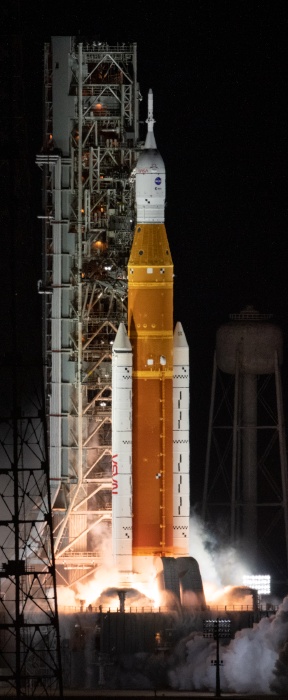
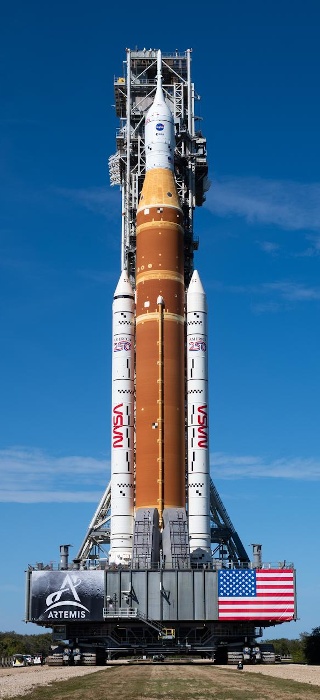
The primary, and at the time of this writing effectively only, purpose of SLS is to serve as launcher for the Orion manned spacecraft in NASA's Artemis moon landing program. The original schedule called for a first flight in 2016, but SLS encountered significant delays and massive cost overruns. The first flight, Artemis 1, eventually lifted off on 16 November 2022. An uncrewed Orion spacecraft was sent to the moon, where it completed two lunar flybys before returning to earth for a controlled reentry and splashdown. The second SLS launch, Artemis 2, flying a crewed Orion to the moon and back, occurred on 1 April 2026.
 |
 | |
| Photos: NASA | ||
| SLS (left: Artemis 1, right: Artemis 2) | ||
Originally, the initial SLS version (Block 1) was to be followed by various upgrades. These included the Block 1B with a new upper stage called EUS (Exploration Upper Stage) and the Block 2 with the EUS and upgraded booster rockets. However, amongst discussions to outright cancel the whole SLS program after its third launch, these plans were all dropped in February 2026. To get the escalating costs under control and to increase the flight rate, the SLS Block 1 configuration is to be standardized. Only the ICPS upper stage will eventually be replaced by the Centaur 5, the upper stage of the United Launch Alliance Vulcan-Centaur launch vehicle.
Specifications
Note: Data given by several sources show slight variations. Figures given below may therefore be inaccurate!
Data for SLS Block 1:
| Length | 98 m (322 ft) |
| Diameter | 8.4 m (27.6 ft) |
| Weight | max. at lift-off: 2610 t (5750000 lb) |
| Payload to LEO | 95 t (209000 lb) |
| Propulsion |
Booster: 2 Northrop Grumman five-segment solid rockets; 29200 kN (6562000 lb) 1st stage: 4 Rocketdyne RS-25D liquid-fueled rockets; 7400 kN (1672000 lb) 2nd stage: 1 Rocketdyne RL10B-2; 110.1 kN (24800 lb) |
Main Sources
[1] Michael H. Gorn, Giuseppe de Chiara, Davide Sivolella: "The Complete Book of Spacecraft", 2nd ed., Motorbooks, 2025
[2] Wikipedia: Space Launch System References
Back to Directory of U.S. Military Rockets and Missiles, Appendix 3
Last Updated: 5 April 2026