Boeing GBI
The GBI (Ground-Based Interceptor) missile is the weapon component of the Ground-Based Midcourse Defense (GMD) system, and consists of a multi-stage rocket booster (BV - Boost Vehicle) and a kinetic kill vehicle (EKV - Exoatmospheric Kill Vehicle) for exoatmospheric interception of ballistic missile warheads. The GMD system, originally known as the National Missile Defense (NMD) program, is one segment of the United States' Ballistic Missile Defense System. As such it is managed by the Missile Defense Agency (MDA), formerly known as Ballistic Missile Defense Organization (BMDO).
The U.S. effort to develop a non-nuclear anti-ballistic missile defense system gained pace in the early 1990s, and by 1996, the program had become known as National Missile Defense. NMD consisted not only of the GBI interceptor missile, but also of new ground- and sea-based X-band radars (XBR), a battle management system (BMC3 - Battle Management Command, Control and Communications), new early warning radars (UEWR - Upgraded Early Warning Radars) and an interface to SBIRS (Space-Based Infrared System) satellites. At that time, is was planned to develop a deployable system until 2000.
In April 1998, Boeing was selected as LSI (Lead Systems Integrator) for the whole NMD program. As such, Boeing also became prime contractor for the interceptor missile and is responsible for integration of booster rocket and kill vehicle.
Booster Vehicle (BV)
The GBI uses a newly developed silo-launched booster rocket, which is optimized for the role of exoatmospheric interceptor. To speed up EKV testing, all early interception tests used so-called "surrogate boosters", which were Lockheed Martin PLVs (Payload Launch Vehicles) made up of upper stages of surplus Minuteman missiles (see section on interception tests below).
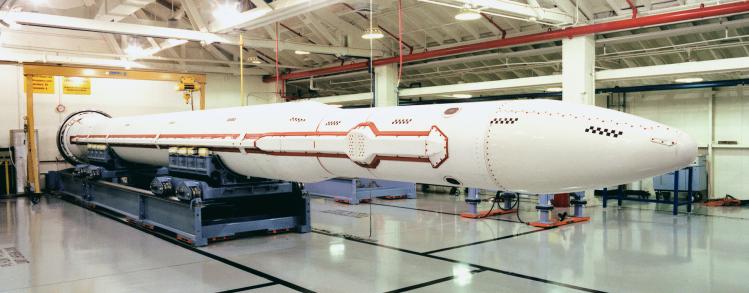
The initial concept for the booster vehicle came from Boeing, and was called the COTS (Commercial Off-the-Shelf) booster, because it used developed and commercially available rocket stages. It was a three-stage design with an ATK GEM-40VN first stage and two Pratt & Whitney (UTC) Orbus-1A upper stages. However, the development didn't proceed as smoothly as expected, and the first test flight (designated BV-2; BV-1 was a pure ground test) only occurred on 31 August 2001 (18 months behind schedule). During this test a first stage anomaly occured, which could have prevented success in an actual intercept attempt. On the second BV flight test (BV-3) on 13 December 2001, the vehicle veered off course and had to be destroyed. Further flight testing of Boeing's BV was cancelled afterwards.
 |
| Photo: Boeing |
| Boeing COTS booster vehicle |
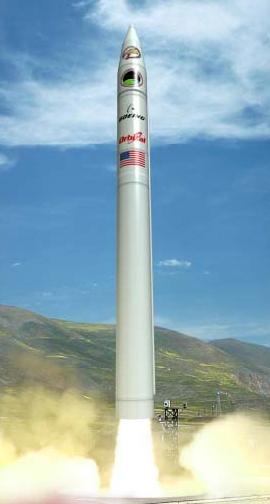
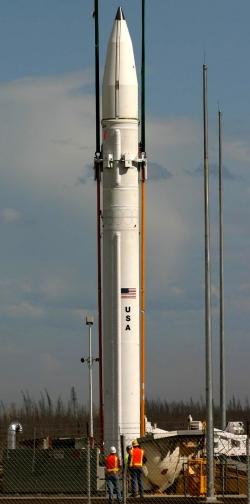
In March 2002, the GBI booster development program was restructured. Boeing's COTS vehicle was transferred to Lockheed Martin Space Systems Company, which developed an improved version known as BV-Plus. Additionally, Orbital Sciences Corp. (OSC) was awarded a contract to build an alternative booster (called OBV - Orbital Booster Vehicle) for the GBI. OSC's three-stage vehicle had its first successful test flight on 6 February 2003, followed by another one (test BV-6) on 16 August 2003. In these tests the vehicle reached altitudes above 1770 km (1100 miles) and ranges of more than 5300 km (3300 miles). The OBV is based on the upper three stages of the company's Taurus XL commercial launch vehicle.
 |
 | |
| Image, Photo: Orbital Sciences | ||
| OSC booster vehicle | ||
Flight testing and production of Lockheed Martin's BV-Plus was delayed because of manufacturing problems with the solid rocket propellant for the second and third stages. The first flight of the BV-Plus (numbered BV-5) finally occured on 9 January 2004, but the following intercept tests, which were originally planned to test both the BV-Plus and the OSC booster, only used the latter design (see also section on interception tests).
Because of the problems with the BV-Plus, OSC eventually received contracts to build the Booster Vehicles for all operational GBI missiles. After several company takeovers, the current prime contractor for the GBI booster is Northrop Grumman.
Exoatmospheric Kill Vehicle (EKV)
In October 1990, the BMDO awarded three contracts for the design of an EKV to Martin Marietta (now Lockheed Martin), Hughes Missiles (now Raytheon) and Rockwell (now Boeing). The work essentially continued the studies and tests of the HOE (Homing Overlay Experiment) and ERIS (Exoatmospheric Reentry Interceptor Subsystem) programs. In a first downselect in 1995, Martin Marietta was eliminated from the EKV competition. The NMD flight tests IFT (Integrated Flight Test)-1 and IFT-2 tested the Boeing and Raytheon EKV seeker designs on 24 June 1997 and 16 January 1998, respectively. After evaluation of the results, Raytheon was selected as prime contractor for the development of the EKV for the operational GBI missile.
 |
| Image: Raytheon |
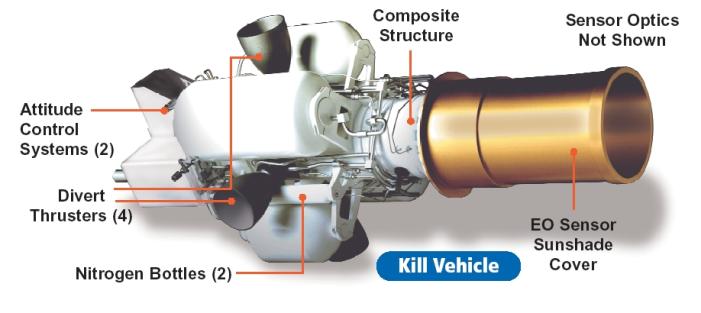
| Raytheon EKV |
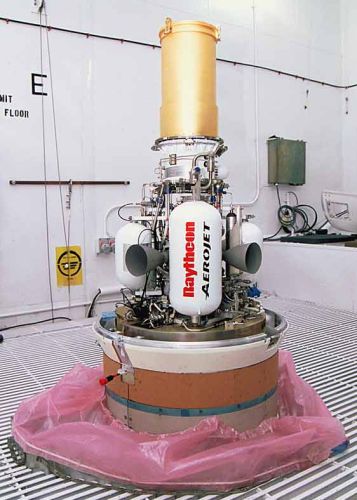
The Raytheon EKV is equipped with an infrared seeker, which is comprised of focal plane arrays and a cooling assembly attached to an optical telescope. The seeker software has to detect and track all incoming objects, discriminate warheads from decoys, and steer the EKV to a head-on collision with a target at closing speeds of more than 25700 km/h (16000 mph). The EKV's manoeuvering system, known as DACS (Divert and Attitude Control System), has four rocket thrusters around the vehicle's body. The vehicle weighs approximately 63 kg (140 lb), is 140 cm (55 in) long and about 60 cm (24 in) in diameter.
 |
| Photo: Boeing |
| Raytheon EKV (used on flight IFT-9) |
After the initial tests, the EKV received some improved components, resulting in the CE-I (Capability Enhancement I) version. Around 2007, the CE-II variant was introduced, which replaced obsolescent components with newer and upgraded ones. There is also an incremental upgrade of CE-II, called CE-II Block 1. In 2016, the RKV (Redesigned Kill Vehicle) program was started to develop a significantly improved EKV. However, RKV was cancelled in 2019 following significant design problems.
Interception Tests
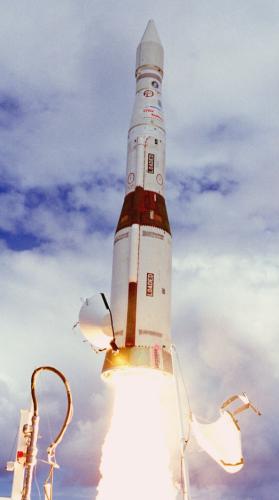
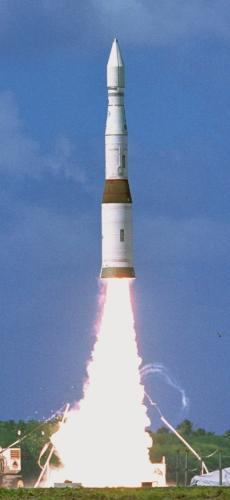
GBI tests, which include a kill vehicle, were initially designated in the IFT (Integrated Flight Test) series (as opposed to pure booster tests, which were designated BV - see booster section). All IFT flights up to IFT-10 have used the Lockheed Martin PLV (Payload Launch Vehicle) as a booster, because no purpose-built GBI booster had been ready. The PLV consisted of the upper two stages of surplus LGM-30F Minuteman II ICBMs (Aerojet SR19-AJ-1 and Hercules M57A1). The designation NLGM-30F, allocated to Minuteman IIs converted to test vehicles, is possibly used for the PLVs. The IFT target missiles not only deploy a dummy warhead but also balloon decoys of varying number and size.
The first intercept attempt by the Raytheon EKV occurred during flight IFT-3 on 2 October 1999. Despite a failure in the EKV's IMU (Inertial Measurement Unit), the mock warhead was successfully intercepted. IFT-4 on 18 January 2000 failed to intercept the warhead, because of a failure in the EKV's sensor cooling system, and IFT-5 on 8 July 2000 was also unsuccessful because the EKV did not separate from the booster. Tests IFT-6 on 14 July 2001 and IFT-7 on 3 December 2001 repeated IFT-5, but were the first to use the XBR (X-Band Radar) developed for the operational system (earlier tests used an older radar and largely relied on a beacon in the mock warhead for target tracking data). XBR performance in IFT-6 was unsatisfactory, but IFT-6 and -7 both successfully intercepted the warhead. In all tests up to IFT-7, only a single large decoy balloon was used, which had a much brighter IR signature than the dummy warhead. This made it comparatively easy for the EKV's seeker logic to discriminate warhead and decoy, and is certainly not a combat-realistic scenario. IFT-8 on 15 March 2002 used three decoys, one large and two small ones. However, every decoy still had a significantly different IR signature than the mock warhead, and the EKV was given discrimination data prior to the test. IFT-9 on 14 October 2002 was presumably similar to IFT-8 (but MDA has classified decoy information from this test on), but used the U.S. Navy's AN/SPY-1 Aegis tracking radar for the first time. Both IFT-8 and -9 intercepted the target warhead. Flight IFT-10 failed on 11 December 2002 because the EKV again failed to separate from the booster.
 |
 | |
| Photos: Boeing | ||
| Lockheed Martin PLV (left: IFT-6; right: IFT-8) | ||
After the second PLV/EKV separation failure in IFT-10, the MDA decided to cancel further tests with the surrogate booster (IFT-11 through -13) and wait for the proper BV to be developed instead. Flight tests IFT-13A and IFT-13B were to test the integration of the EKV with the Lockheed Martin and OSC boosters, respectively, but did not include an intercept attempt. Because of the manufacturing problems with the Lockheed Martin BV (see booster section), IFT-13A was postponed and eventually cancelled. IFT-13B was successfully conducted on 26 January 2004, and tested the integration of several components of the GMD system, including the OSC booster vehicle, the EKV, the XBR prototype and the battle mananagment system (BMC3).
The next two flight tests, IFT-13C and IFT-14, also used the OSC booster. IFT-13C was an all-up test of the GMD system, where an interception was possible but not the primary objective. IFT-14, planned to follow about two months after IFT-13C, was to be the first actual interception test with the OSC booster. Originally planned for mid-2004, the IFT-13C/14 tests had been postponed several times. On 14 December 2004, IFT-13C was finally ready to go. However, the interceptor booster shut down immediately before the planned lift-off, after the target had already been launched. It turned out that a software error in a pre-launch check routine led to the abort. The test objectives of IFT-13C were to be repeated by IFT-14 on 14 February 2005, but again the interceptor missile did not launch. This time, a support arm, which holds the missile in the silo, did not properly retract before the attempted launch.
Flight testing eventually resumed on 13 December with a test labeled "Flight Test-1" (the IFT numbering sequence was no longer used). This test, which was to validate GMD component interoperability, was successful, but did not include an actual target intercept. Tests FT-2 on 1 September 2006 and FT-3a (a.k.a. FTG-03a, FTG = Flight Test GBI) on 28 September 2007 both resulted in a successful target interception. Another test in May 2007 had to be aborted after the STARS target missile had failed.
The next intercept test, FTG-05 on 5 December 2008, was a success, but three subsequent tests, FTG-06 on 31 January 2010, FTG-06a on 15 December 2010 and FTG-07 on 5 July 2013, all failed to achieve an interception. However, the final four tests at the time of this writing, FTG-06b on 22 June 2014, FTG-15 on 30 May 2017, FTG-11 on 25 March 2019 and FTG-12 on 11 December 2023, all successfully intercepted their targets. FTG-12 was the first intercept to use the BV in a two-stage mode, where the EKV is released without firing the third stage. The reduces the minimum effective engagement range of the system.
Operational System
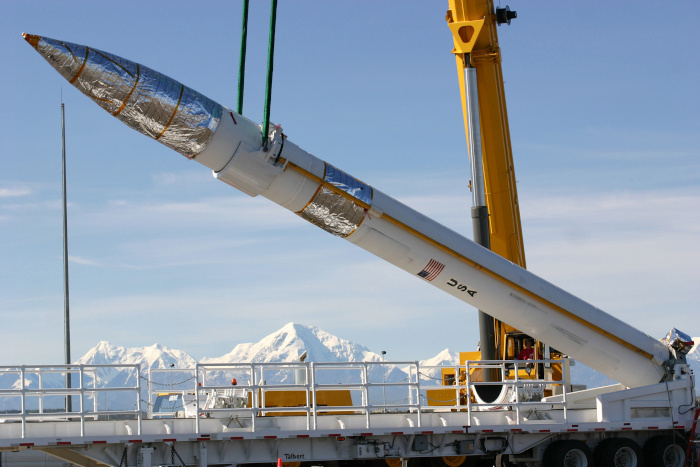
In December 2002, President Bush directed the Department of Defense to field an initial missile defense capability by the end of 2004. This was to include ten GMD interceptors in 2004 and ten more by 2005. The first GBI missile silos were built at Fort Greely, Alaska, and formed (in connection with supporting guidance system components at Eareckson AFS on Shemya Island) what was called a "Missile Defense Testbed". The second GBI base is Vandenberg SFB, California. In July 2004, the first GBI missile was installed in a silo at Fort Greely, and by the end of that year, five more interceptors had been deployed at that location. Since 2017, 40 GBI silos are operational at Fort Greely, with an additional 4 at Vandenberg. About half of the interceptors are equipped with a CE-II EKV.
 |
| Photo: Sgt. Jack W. Carlson III, U.S. Army |
| GBI |
In 2025, Boeing finished the construction of an additional 20 silos at Fort Greely, which will eventually bring the GMD active interceptor count to 64. The MDA plans to complement and eventually replace the GBI missiles by an improved design developed by Lockheed Martin under the NGI (Next Generation Interceptor) program. At the time of this writing, the first NGI missiles are expected for the 2027/28 time frame.
Specifications
Note: Data given by several sources show slight variations. Figures given below may therefore be inaccurate!
Data for GBI:
| Length | 16.8 m (55 ft) |
| Diameter | 1.27 m (50 in) |
| Weight | 12700 kg (28000 lb) |
| Speed | ca. 7-8 km/s (at 3rd stage burnout) |
| Ceiling | 2000 km (1250 miles) |
| Propulsion | 1st stage: Alliant Tech Orion 50SXLG solid-fueled rocket; 441 kN (99000 lb) 2nd stage: Alliant Tech Orion 50XL solid-fueled rocket; 153 kN (34500 lb) 3rd stage: Alliant Tech Orion 38 solid-fueled rocket; 32 kN (7200 lb) |
| Warhead | EKV "hit-to-kill" vehicle |
Main Sources
[1] Boeing Website: Ground-based
Midcourse Defense [Internet Archive, 2008]
[2] Raytheon Website: Missile Defense
Program Information [Internet Archive, 2006]
[3] Orbital Sciences Website [Internet Archive, 2005]
[4] Missile Defense Agency Website
[5] CDI (Center for Defense Information) Website:
Missile Defense [Internet Archive, 2008]
[6] GlobalSecurity.org Website: National Missile Defense
[7] Missile Defense
Agency Booster Rocket Program, DOD News Release No. 831-03, 7 November 2003
[8] Wikipedia: GMD Flight Tests
[9] Defense News, Jen Judson:
Boeing
grows Alaska-based homeland missile defense silo count by 20, March 2025
Back to Directory of U.S. Military Rockets and Missiles, Appendix 4
Last Updated: 7 February 2026