SpaceX Starship
SpaceX had plans to develop a super-heavy space launch vehicle almost from its very beginning. These plans became more concrete in the mid-2010s under various names, including "Interplanetary Transport System" and "BFR" (Big Falcon Rocket). By 2019, the forthcoming system was called Starship, with a booster stage called Super Heavy and an upper stage also called Starship (or sometimes plain "Ship"). The launch vehicle was designed from the beginning to be fully reusable.
The Super Heavy booster is powered by 33 SpaceX Raptor engines, burning liquid oxygen and methane. The Starship upper stage uses six Raptors, three of which are optimized for sea-level and three for vacuum. The whole vehicle uses "hot staging", i.e. the booster shuts down most of its engines, and the upper stage fires before stage separation. After separation, the booster rotates, and uses its 13 inner gimballed engines to cancel out its forward velocity and orient itself for reentry and return to the launch site. During reentry, attitude is controlled by four extendable grid fins, and shortly before landing, the 13 gimbal engines reignite. The booster doesn't actually touch down on the ground, but is instead "caught" by a large device called "Mechazilla", mounted to the launch tower.
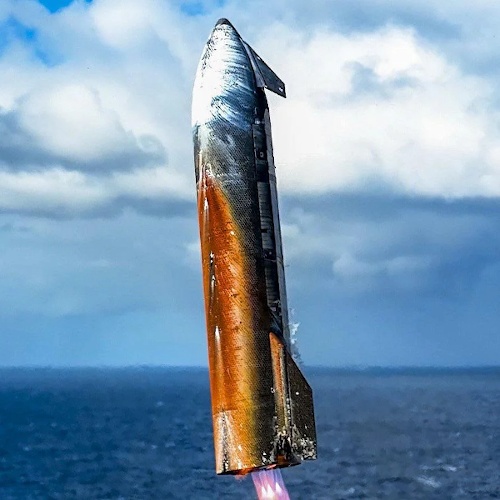
After a successful mission, the Starship upper stage can also be deorbited for a controlled catch by a "Mechazilla". It is controlled by two pairs of large flaps, at the nose and tail of the vehicle, and the three gimballed sea-level Raptor engines. The side facing the slipstream during the initial high angle-of-attack reentry is equipped with a ceramic tile heat shield, similar to the Space Shuttle. For the middle phase of the landing approach, Starship does a so-called "belly flop", to dive through the atmosphere at an angle of about 60 degrees. For the actual landing phase, the craft maneuvers itself to a vertical position, and reignites its engines for a controlled final descent.
| Stage | Length | Diameter | Engine(s) | Fuel | Thrust |
|---|---|---|---|---|---|
| 1 | 71 m | 9 m | 33 SpaceX Raptor | LOX/methane | 2250 kN each |
| 2 | 52 m | 9 m | 3 SpaceX Raptor 3 SpaceX Raptor Vacuum | LOX/methane | 14700 kN total |
Specifications for Starship stages
Flight testing of Starship upper stage prototypes began in 2020, with a total of 7 flights to altitudes of not more than 12.5 km (41000 ft). These flights validated the low-altitude phases of the reentry and landing concept.
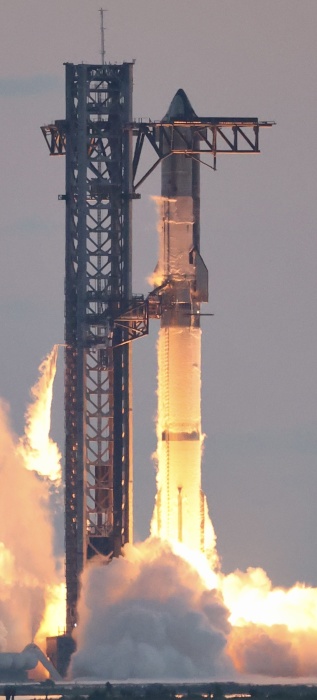
Test flights of full two-stage Starship launch vehicles are called IFT (Integrated Flight Test) by SpaceX. The first of these occurred on 20 April 2023, but ended prematurely when the booster went out of control. The first six IFT missions used the initial Starship configuration, also called Version 1 (V1) or Block 1, with only incremental changes between flights.
| Flight | Date | Attempted Trajectory | Final Results |
|---|---|---|---|
| IFT-1 | 20 April 2023 | Transatmospheric | Booster went out of control before stage separation |
| IFT-2 | 18 November 2023 | Transatmospheric | - Booster exploded during reentry burn - Upper stage failed before reachingthe planned orbit |
| IFT-3 | 14 March 2024 | Suborbital | - Booster failed during landing burn - Upper stage reached planned orbit, but disintegrated during reentry |
| IFT-4 | 6 June 2024 | Suborbital | - Booster succeeded with controlled splashdown - Upper stage flight path, reentry and controlled splashdown as planned |
| IFT-5 | 13 October 2024 | Suborbital | - Booster successfully recovered at launch site - Upper stage flight path, reentry and controlled splashdown as planned |
| IFT-6 | 19 November 2024 | Transatmospheric | - Booster recovery aborted; diverted to controlled splashdown - Upper stage flight path, reentry and controlled splashdown as planned |
Starship V1 Integrated Flight Tests
 |
 | |
| Photos: SpaceX | ||
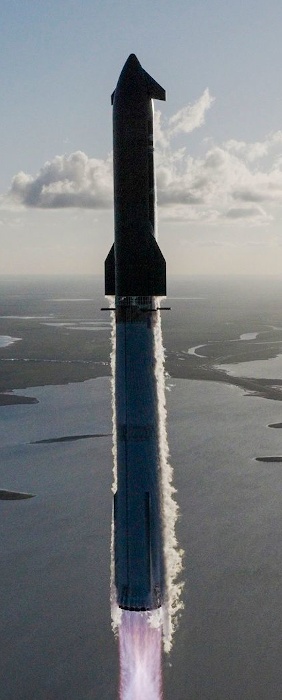
| Starship V1 (IFT-5) | Starship V2 (IFT-11) | |
Beginning with flight IFT-7, booster and upper stage were of an upgraded configuration, also called Version 2 (V2) or Block 2. The most visible external changes were revised positions of the forward Starship flaps (moved to the leeward reentry position, and set only 120° apart) and a slightly longer interstage structure, integrated into the booster. V2 also had increased propellant load and uprated Raptor engines. In the V2 tests, the upper stage carried simulator masses, to test the deployment system for Starlink satellites. IFT-9 and -11 both used a booster stage, which had been successfully recovered after a previous flight.
| Flight | Date | Attempted Trajectory | Final Results |
|---|---|---|---|
| IFT-7 | 16 January 2025 | Transatmospheric | - Booster successfully recovered at launch site (reused for IFT-9) - Upper stage exploded during initial engine burn |
| IFT-8 | 6 March 2025 | Transatmospheric | - Booster successfully recovered at launch site (reused for IFT-11) - Upper stage exploded during initial engine burn |
| IFT-9 | 27 May 2025 | Transatmospheric | - Booster lost during reentry - Upper stage failed to release simulated satellites; control lost before reentry because of a fuel leak |
| IFT-10 | 26 August 2025 | Transatmospheric | - Booster did a controlled splashdown, after simulating an engine out on descent - Upper stage released simulated satellites and descended to a controlled splashdown |
| IFT-11 | 13 October 2025 | Transatmospheric | - Booster descended to a controlled splashdown - Upper stage released simulated satellites, and did a maneuvering reentry to a controlled splashdown |
Starship V2 Integrated Flight Tests
 |
| Photo: SpaceX |
| Starship Upper Stage (IFT-10) |
Upcoming flights will use a further upgraded V3 variant of the vehicle, which will likely be using improved Raptor engines as well as hardware for the planned in-orbit Starship-to-Starship refuelling capability. So far, no true orbital launch of a Starship has been attempted. At the time of this writing, the first orbital flight is planned for IFT-13, probably depending on the outcome of IFT-12.
Apart from being intended as a generic launch vehicle for Starlink satellites and large commercial payloads, Starship is planned to play a major role in NASA's Artemis moon-landing program. An upper-stage variant called Starship HLS (Human Landing System) is to be used for the actual manned moon landing and subsequent return to the Orion crew spacecraft. Another version, Starship "Depot", will act as a propellant depot in LEO, to refuel the HLS stage before it continues toward a lunar orbit.
Specifications
Note: Data given by several sources show slight variations. Figures given below may therefore be inaccurate!
Data for Starship V2:
| Length | 123 m (403 ft) |
| Diameter | 9 m (29.5 ft) |
| Weight | max. at lift-off: ca. 5000 t (11 Mlb) |
| Payload to LEO | fully reusable: 150 t (330000 lb) expendable: 250 t (550000 lb) |
| Propulsion |
1st stage: 33 Raptor liquid-fueled rockets; 74300 kN (16.7 Mlb) 2nd stage: 3 Raptor + 3 Raptor Vacuum liquid-fueled rockets; 14700 kN (3.3 Mlb) |
Main Sources
[1] SpaceX Website: Starship
[2] Michael H. Gorn, Giuseppe de Chiara, Davide Sivolella: "The Complete Book of Spacecraft", 2nd ed., Motorbooks, 2025
[3] Wikipedia: List of Starship launches
[4] Wikipedia: SpaceX Starship References
Back to Directory of U.S. Military Rockets and Missiles, Appendix 3
Last Updated: 9 March 2026