Boeing (Rockwell) NS-7 Navstar GPS
GPS Block I
The designation NS-7A referred to the Navstar series of navigational satellite also known as Navigational Development Satellite (NDS) and the Global Positioning System (GPS). The satellites were developed for the US Navy by Rockwell and four satellites provided a positional fix with an accuracy of 30 m. It was also made available to civilian users. The 525 kg Navstar satellites were fitted with three rubidium clocks and one caesium clock. They transmitted at 1575.42 MHz for civilian users and at 1227.6 MHz for military users.
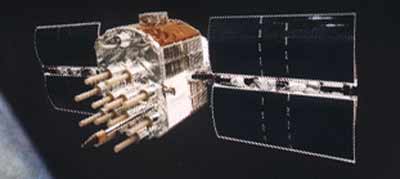 |
| Image: Author's collection |
| NS-7A Navstar-1 (1978-020A) |
| Name | Intl. Designation | Launch | Notes |
|---|---|---|---|
| Navstar-1 | 1978-020A | 22 Feb 1978 | Also known as OPS 5111 |
| Navstar-2 | 1978-047A | 13 May 1978 | Also known as OPS 5112 |
| Navstar-3 | 1978-093A | 7 Oct 1978 | Also known as OPS 5113 |
| Navstar-4 | 1978-112A | 11 Dec 1978 | Also known as OPS 5114 |
| Navstar-5 | 1980-011A | 9 Feb 1980 | Also known as OPS 5117 |
| Navstar-6 | 1980-032A | 26 Apr 1980 | Also known as OPS 5118 |
| Navstar-7 | --- | 18-Dec-1981 | Failed to orbit |
| Navstar-8 | 1983-072A | 14 Jul 1983 | Also known as OPS 9794 |
| Navstar-9 | 1984-059A | 13 Jun 1984 | Also known as USA 1 |
| Navstar-10 | 1984-097A | 8 Sep 1984 | Also known as USA 5 |
| Navstar-11 | 1985-093A | 9 Oct 1985 | Also known as USA 10 |
Launch dates of the Navstar series
GPS Block II
The Navstar 2 system, designated as NS-7B, was also built by Rockwell. The operational system consisted of 21 satellites. Each 1665 kg satellite was equipped with an atomic clock with an accuracy of 1 second in 300,000 years. The transmissions were at 1575.42 MHz for civilian purposes and 1227.6 MHz for military purposes.
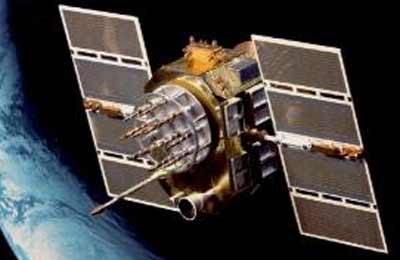 |
| Image: Author's collection |
| NS-7B Navstar 2-1 (1989-013A) |
| Name | Intl. Designation | Launch | Notes |
|---|---|---|---|
| Navstar 2-1 | 1989-013A | 14 Feb 1989 | Also known as USA 35 |
| Navstar 2-2 | 1989-044A | 10 Jun 1989 | Also known as USA 38 |
| Navstar 2-3 | 1989-064A | 18 Aug 1989 | Also known as USA 42 |
| Navstar 2-4 | 1989-085A | 21 Oct 1989 | Also known as USA 47 |
| Navstar 2-5 | 1989-097A | 11 Dec 1989 | Also known as USA 49 |
| Navstar 2-6 | 1990-008A | 24 Jan 1990 | Also known as USA 50 |
| Navstar 2-7 | 1990-025A | 26 Mar 1990 | Also known as USA 54 |
| Navstar 2-8 | 1990-068A | 2 Aug 1990 | Also known as USA 63 |
| Navstar 2-9 | 1990-088A | 1 Oct 1990 | Also known as USA 64 |
Launch dates of the Navstar 2 series
The Navstar 2A series, designated as NS-7C, was similar to the Navstar 2 series but carried improved instrumentation.
| Name | Intl. Designation | Launch | Notes |
|---|---|---|---|
| Navstar 2A-1 | 1990-103A | 26 Nov 1990 | Also known as USA 66 |
| Navstar 2A-2 | 1991-047A | 4 Jul 1991 | Also known as USA 71 |
| Navstar 2A-3 | 1992-009A | 23 Feb 1992 | Also known as USA 79 |
| Navstar 2A-4 | 1992-019A | 10 Apr 1992 | Also known as USA 80 |
| Navstar 2A-5 | 1992-039A | 7 Jul 1992 | Also known as USA 83 |
| Navstar 2A-6 | 1992-058A | 9 Sep 1992 | Also known as USA 84 |
| Navstar 2A-7 | 1992-079A | 23 Nov 1992 | Also known as USA 85 |
| Navstar 2A-8 | 1992-089A | 18 Dec 1992 | Also known as USA 87 |
| Navstar 2A-9 | 1993-007A | 3 Feb 1993 | Also known as USA 88 |
| Navstar 2A-10 | 1993-017A | 30 Mar 1993 | Also known as USA 90 |
| Navstar 2A-11 | 1993-032A | 13 May 1993 | Also known as USA 91 |
| Navstar 2A-12 | 1993-042A | 26 Jun 1993 | Also known as USA 92 |
| Navstar 2A-13 | 1993-054A | 30 Aug 1993 | Also known as USA 94 |
| Navstar 2A-14 | 1993-068A | 26 Oct 1993 | Also known as USA 96 |
| Navstar 2A-15 | 1994-016A | 10 Mar 1994 | Also known as USA 100 |
| Navstar 2A-16 | 1996-019A | 28 Mar 1996 | Also known as USA 117 |
| Navstar 2A-17 | 1996-041A | 16 Jul 1996 | Also known as USA 126 |
| Navstar 2A-18 | 1996-056A | 12 Sep 1996 | Also known as USA 128 |
| Navstar 2A-19 | 1997-067A | 5 Nov 1997 | Also known as USA 134 |
Launch dates of the Navstar 2A series
Further improvements to the instrumentation was introduced with the Navstar 2R ("R" for "replenishment") series, which was also designated as NS-7D. Whilst these satellites used the original Rockwell design, they were in fact built by Lockheed Martin. Navstar 2R-M was a "modernised" version (hence the "M") of the 2R series. The series used the remaining eight unlaunched 2R satellites but converted with increased power for existing signals and two new military signals as well as a second civilian signal, along with a redesigned external antenna panel and more efficient transmitters. The mass of the satellites increased by 28 kg to 2073 kg.
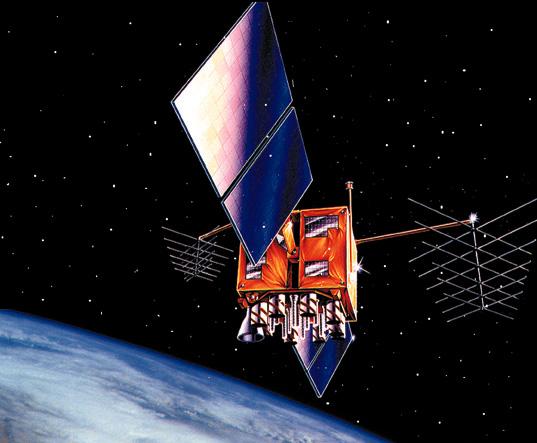 |
| Image: Lockheed Martin |
| NS-7D |
| Name | Intl. Designation | Launch | Notes |
|---|---|---|---|
| GPS 2R-1 | --- | 17-Jan-1997 | Failed to orbit |
| GPS 2R-2 | 1997-035A | 23 Jul 1997 | Also known as USA 132 |
| GPS 2R-3 | 1999-055A | 7 Oct 1999 | Also known as USA 145 |
| GPS 2R-4 | 2000-025A | 11 May 2000 | Also known as USA 150 |
| GPS 2R-5 | 2000-040A | 16 Jul 2000 | Also known as USA 151 |
| GPS 2R-6 | 2000-071A | 10 Nov 2000 | Also known as USA 154 |
| GPS 2R-7 | 2001-004A | 30 Jan 2001 | Also known as USA 156 |
| GPS 2R-8 | 2003-005A | 29 Jan 2003 | Also known as USA 166 |
| GPS 2R-9 | 2003-010A | 31 Mar 2003 | Also known as USA 168 |
| GPS 2R-10 | 2003-058A | 21 Dec 2003 | Also known as USA 175 |
| GPS 2R-11 | 2004-009A | 20 Mar 2004 | Also known as USA 177 |
| GPS 2R-12 | 2004-023A | 23 Jun 2004 | Also known as USA 178 |
| GPS 2R-13 | 2004-045A | 6 Nov 2004 | Also known as USA 180 |
| GPS 2RM-1 | 2005-038A | 26 Sep 2005 | ex GPS-2R-14; also known as USA 183 |
| GPS 2RM-2 | 2006-042A | 26 Sep 2006 | ex GPS-2R-15; also known as USA 190 |
| GPS 2RM-3 | 2006-052A | 17 Nov 2005 | ex GPS-2R-16; also known as USA 192 |
| GPS 2RM-4 | 2007-047A | 17 Oct 2007 | ex GPS-2R-17; also known as USA 196 |
| GPS 2RM-5 | 2007-062A | 20 Dec 2007 | ex GPS-2R-18; also known as USA 199 |
| GPS 2RM-6 | 2008-012A | 15 Mar 2008 | ex GPS-2R-19; also known as USA 201 |
| GPS 2RM-7 | 2009-014A | 24 Mar 2009 | ex GPS-2R-20; also known as USA 203 |
| GPS 2RM-8 | 2009-043A | 7 Aug 2009 | ex GPS-2R-21; also known as USA 206 |
Launch dates of the GPS 2R (Navstar 2R) series
The designation NS-7E refers to the Navstar 2F series of satellites. Boeing (which now owns Rockwell) has received an order to build six against a requirement of 33 by 2012. As it is recognised that over the years that the Navstar 2F series will be launched, technology and needs will change, Boeing has adopted a modular approach which will allow them to meet those changes.
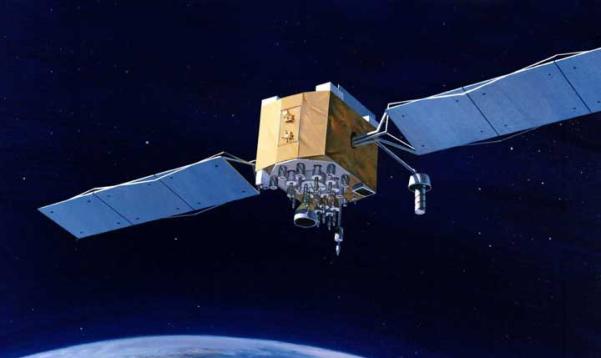 |
| Image: Boeing |
| NS-7E |
| Name | Intl. Designation | Launch | Notes |
|---|---|---|---|
| GPS 2F-1 | 2010-022A | 28 May 2010 | Also known as USA 213 |
| GPS 2F-2 | 2011-036A | 16 Jul 2011 | Also known as USA 232 |
| GPS 2F-3 | 2012-053A | 4 Oct 2012 | Also known as USA 239 |
| GPS 2F-4 | 2013-023A | 15 May 2013 | Also known as USA 242 |
| GPS 2F-5 | 2014-008A | 21 Feb 2014 | Also known as USA 248 |
| GPS 2F-6 | 2014-026A | 17 May 2014 | Also known as USA 251 |
| GPS 2F-7 | 2014-045A | 2 Aug 2014 | Also known as USA 256 |
| GPS 2F-8 | 2014-068A | 29 Oct 2014 | Also known as USA 258 |
| GPS 2F-9 | 2015-013A | 25 Mar 2015 | Also known as USA 260 |
| GPS 2F-10 | 2015-033A | 15 Jul 2015 | Also known as USA 262 |
| GPS 2F-11 | 2015-062A | 31 Oct 2015 | Also known as USA 265 |
| GPS 2F-12 | 2016-007A | 5 Feb 2016 | Also known as USA 266 |
Launch dates of the GPS 2F (Navstar 2F) series
GPS Block III
The third generation of GPS satellites is known as GPS Block III or simply GPS 3. Prime contractor is Lockheed Martin, building on their experience with the GPS 2R series. A total of 10 GPS Block III satellites is on order. A major improvement of the GPS 3 satellites are new navigation signals to increase availability and accuracy for civilian and military users. Additionally, the satellites have a directional antenna to transmit the latest military signal standard (called M-Code) with high power to a specific area on Earth.
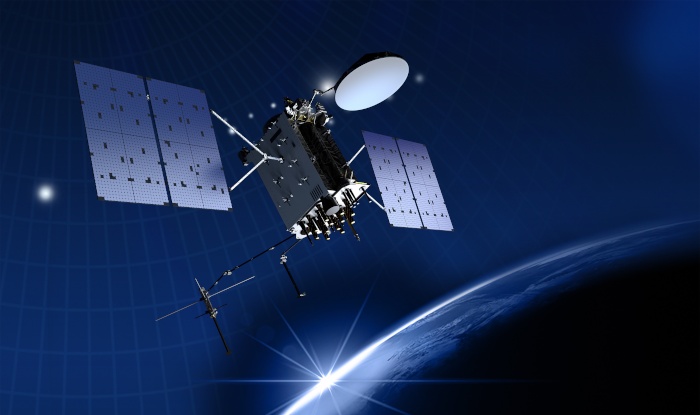 |
| Image: Lockheed Martin / USSF |
| GPS Block III |
| Name | Intl. Designation | Launch | Notes |
|---|---|---|---|
| GPS 3-1 | 2018-109A | 23 Dec 2018 | Also known as USA 289 |
| GPS 3-2 | 2019-056A | 22 Aug 2019 | Also known as USA 293 |
| GPS 3-3 | 2020-041A | 30 Jun 2020 | Also known as USA 304 |
| GPS 3-4 | 2020-078A | 5 Nov 2020 | Also known as USA 309 |
| GPS 3-5 | 2021-054A | 17 Jun 2021 | Also known as USA 319 |
| GPS 3-6 | 2023-009A | 18 Jan 2023 | Also known as USA 343 |
| GPS 3-7 | 2024-242A | 17 Dec 2024 | Also known as USA 440 |
| GPS 3-8 | 2025-116A | 30 May 2025 | Also known as USA 545 |
| GPS 3-9 | 2026-017A | 28 Jan 2026 | Also known as USA 581 |
| GPS 3-10 | 2026-087A | 21 Apr 2026 | Also known as USA 585 |
Launch dates of the GPS 3 (Navstar 3) series
After the 10 Block III satellites, production will switch to the further improved Block IIIF. Current plans call for the launch of 22 Block IIIF satellites.
Background history
Navigational satellites are essentially radio transmitters of which the orbital positions are known. Through analysing the signals from three satellites, a navigator is not only able to determine his longitude and latitude but also, where appropriate, his altitude.
The early navigational satellites in the Transit series used a radio-Doppler navigation method in which the ship's position was calculated from the observed change in the received frequency of the satellite radio transmission as the satellite passes across the sky. This technique is based on the principle that the orbit of a satellite can be accurately computed by the analysis of the Doppler shift of the radio transmissions by the satellites. The accuracy is, however, limited by the frequency stability of the satellite transmissions and the ability to predict the satellite's orbit between the time it is measured by a ground tracking station and the time the user observed the satellite.
Another method is based on time ranging. Here the user calculates his distance from a satellite by a measurement of the time that the radio signal of the satellite takes to cover the distance to the receiver. To achieve a reasonable accuracy, this method requires three separate satellites and a very accurate clock.
Transit series
The early navigational satellites of the United States were of an experimental nature. They were sponsored by the U.S. Navy and were built by RCA. The Transit-1A and -2 series carried two ultrastable oscillators, an electronic clock and four frequency transmitters which operated in the 162/216 MHz and 53/324 MHz bands. Transit-3 carried in addition a small magnetic memory. The Transit-4 series, which was of a different design, was unique in that they carried a Supplementary Nuclear Power (SNAP) source to generate the satellite's power requirements. Transmitters operated at 150/400 MHz. The Transit-5 series satellites were of an octagonal shape and carried dual frequency transmitters as well as a 30 m gravity gradient stabilisation boom. The 5A sub-series were powered by solar cells whilst the 5B sub-series carried a SNAP-9A nuclear power source. The 5C sub-series reverted again to solar cells.
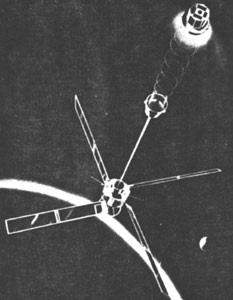 |
| Image: Author's collection |
| Transit-5C1 (1964-026A) |
| Name | Intl. Designation | Launch | Re-entry | Notes |
|---|---|---|---|---|
| Transit-1A | --- | 17 Sep 1959 | --- | Failed to orbit |
| Transit-1B | 1960 γ2 | 13 Apr 1960 | 5 Oct 1967 | |
| Transit-2A | 1960 η1 | 22 Jun 1960 | ||
| Transit-3A | --- | 30 Nov 1960 | --- | Failed to orbit |
| Transit-3B | 1961 η1 | 21 Feb 1961 | 30 Mar 1961 | Failed to separate from Lofti-1 |
| Transit-4A | 1961 ο1 | 29 Jun 1961 | ||
| Transit-4B | 1961 αη1 | 15 Nov 1961 | ||
| Transit-5A1 | 1962 βψ1 | 19 Dec 1962 | 25 Sep 1986 | |
| Transit-5A2 | --- | 5 Apr 1963 | --- | Also known as OPS 0804; failed to orbit |
| Transit-5A3 | 1963-022A | 16 Jun 1963 | 3 Aug 1990 | |
| Transit-5BN1 | 1963-038B | 28 Sep 1963 | ||
| Transit-5BN2 | 1963-049B | 5 Dec 1963 | ||
| Transit-5BN3 | --- | 21 Apr 1964 | --- | Failed to orbit |
| Transit-5C1 | 1964-026A | 4 Jun 1964 | Also known as OPS 4412 |
Launch dates of the Transit series
NNSS
The Navy Navigational Satellite System (NNSS), also called Oscar or Transit-O, was the first operational system. The principal objective was to provide positioning facilities with an accuracy of 150 m to submarines carrying Polaris missiles. At a later stage the system was also made available to civilian users. The satellites transmitted at 150 MHz and 400 MHz. Whilst six satellites provide a useful coverage, additional satellites have been launched as in-orbit spares. The satellites had an initial mass of 32 kg and in total 32 were built by RCA. They have been identified by the third and fourth characters in the numeric designation whilst the meaning of the numeric '3' is not known.
A number of the satellites were converted for other uses as Transat (#11), P76-5 (#15), Hilat (#16) and Polar Bear (#17). Spacecraft #22 was used in 1992 ground tests to assess the impact of aluminium projectiles bombarded onto the spacecraft structure. Of the remaining spacecraft #21, #26 and #28, one was given to Naval Post Graduate School and two went to the Applied Research Laboratory of the University of Texas, Austin. Of these three, one was destroyed in impact tests like spacecraft #22. The satellites launched in the 1985/88 period are sometimes referred to as Stacked Oscar On Scout (SOOS).
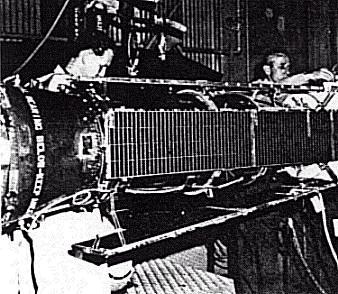 |
| Image: Author's collection |
| NNSS-30010 (1964-063B) |
| Name | Intl. Designation | Launch | Re-entry | Notes |
|---|---|---|---|---|
| Transit-O 1 (NNSS 30010) | 1964-063B | 6 Oct 1964 | Also known as OPS 5798 | |
| Transit-O 2 (NNSS 30020) | 1964-083D | 12 Dec 1964 | Also known as OPS 6582 | |
| Transit-O 3 (NNSS 30030) | 1965-017A | 11 Mar 1965 | 14-Jun-1965 | Also known as OPS 7087 |
| Transit-O 4 (NNSS 30040) | 1965-048A | 24 Jun 1965 | Also known as OPS 8480 | |
| Transit-O 5 (NNSS 30050) | 1965-065F | 13 Aug 1965 | Also known as OPS 8464 | |
| Transit-O 6 (NNSS 30060) | 1965-109A | 21 Dec 1965 | Also known as OPS 1509 | |
| Transit-O 7 (NNSS 30070) | 1966-005A | 28 Jan 1966 | Also known as OPS 1593 | |
| Transit-O 8 (NNSS 30080) | 1966-024A | 26 Mar 1966 | Also known as OPS 1117 | |
| Transit-O 9 (NNSS 30090) | 1966-041A | 19 May 1966 | Also known as OPS 0082 | |
| Transit-O 10 (NNSS 30100) | 1966-076A | 18 Aug 1966 | Also known as OPS 2366 | |
| Transit-O 11 (NNSS 30110) | Used as Transat | |||
| Transit-O 12 (NNSS 30120) | 1967-034A | 14 Apr 1967 | Also known as OPS 0100 | |
| Transit-O 13 (NNSS 30130) | 1967-048A | 18 May 1967 | Also known as OPS 7218 | |
| Transit-O 14 (NNSS 30140) | 1967-092A | 25 Sep 1967 | Also known as OPS 4947 | |
| Transit-O 15 (NNSS 30150) | Used as P76-5 | |||
| Transit-O 16 (NNSS 30160) | Used as Hilat | |||
| Transit-O 17 (NNSS 30170) | Used as Polar Bear | |||
| Transit-O 18 (NNSS 30180) | 1968-012A | 2 Mar 1968 | Also known as OPS 7034 | |
| Transit-O 19 (NNSS 30190) | 1970-067A | 27 Aug 1970 | Also known as OPS 1999 | |
| Transit-O 20 (NNSS 30200) | 1973-081A | 30 Oct 1973 | ||
| Transit-O 21 (NNSS 30210) | Not used | |||
| Transit-O 22 (NNSS 30220) | Expended in tests, 1992 | |||
| Transit-O 23 (NNSS 30230) | 1988-033A | 26 Apr 1988 | ||
| Transit-O 24 (NNSS 30240) | 1985-066A | 3 Aug 1985 | ||
| Transit-O 25 (NNSS 30250) | 1988-074A | 25 Aug 1988 | ||
| TRANSIT O 26 (NNSS 30260) | Not used | |||
| Transit-O 27 (NNSS 30270) | 1987-080A | 16 Sep 1987 | ||
| TRANSIT O 28 (NNSS 30280) | Not used | |||
| Transit-O 29 (NNSS 30290) | 1987-080B | 16 Sep 1987 | ||
| Transit-O 30 (NNSS 30300) | 1985-066B | 3 Aug 1985 | ||
| Transit-O 31 (NNSS 30310) | 1988-074B | 25 Aug 1988 | ||
| Transit-O 32 (NNSS 30320) | 1988-033B | 26 Apr 1988 | ||
Launch dates of the NNSS series
Timation/NTS
The Timation or Navigation Technology Satellites (NTS) series tested new equipment to be used in the Global Positioning System (GPS). Timation-1 carried two high-precision quartz clocks for accurate measurements based on a three dimensional navigation technique. Timation-2 carried improved equipment and a dual frequency transmitter operating at 150/400 MHz. In addition Timation-3 or NTS-1 carried two rubidium vapor atomic clocks and operated at the 335 MHz and 1580 MHz frequencies whilst NTS-2 tested a ceasium clock. The satellite also carried an experimental solar array.
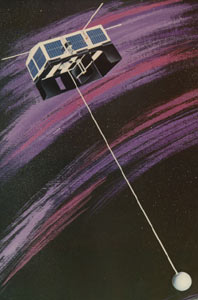 |
| Image: Author's collection |
| Timation-1 (1967-053E) |
| Name | Intl. Designation | Launch | Re-entry | Notes |
|---|---|---|---|---|
| Timation-1 | 1967-053E | 31 May 1967 | ||
| Timation-2 | 1969-082C | 30 Sep 1969 | 30-Oct-1970 | Also known as OPS 7613 |
| Timation-3 | 1974-054A | 14 Jul 1974 | Also known as NTS-1 and OPS 7518 | |
| NTS-2 | 1977-053A | 23 Jun 1977 |
Launch dates of the Timation/NTS series
TIP
The satellites in the Transit Improvement Program (TIP) were considered as a precursor to the Nova series and incorporated the Disturbance Compensating System (Discos), hence Transit Improved And Discos (Triad), which was designed to maintain position in orbit by correcting disturbances caused by solar wind and atmospheric resistance. In addition TIP-1 carried a radio-isotope thermal generator.
| Name | Intl. Designation | Launch | Re-entry | Notes |
|---|---|---|---|---|
| TIP-1 | 1972-069A | 2 Sep 1972 | Also known as Triad | |
| TIP-2 | 1975-099A | 12 Oct 1975 | 26 May 1991 | |
| TIP-3 | 1976-089A | 1 Sep 1976 | 30 May 1981 |
Launch dates of the TIP series
Nova
The Nova military navigational satellite had a mass of 166 kg and tested new instruments and techniques. They also carried a tri-axis vector magnetometer, four solar detectors and an internal mass displacement detector.
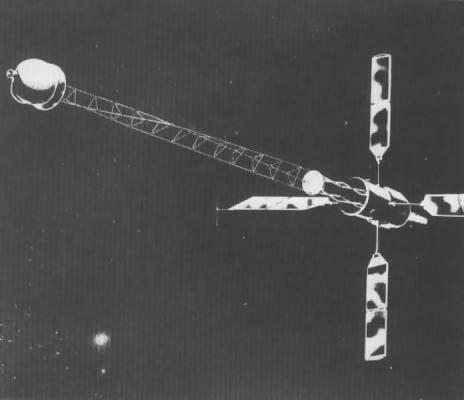 |
| Image: Author's collection |
| Nova-1 (1981-044A) |
| Name | Intl. Designation | Launch | Re-entry | Notes |
|---|---|---|---|---|
| Nova-1 | 1981-044A | 15 May 1981 | Also known as NNSS 30480 | |
| Nova-2 | 1988-052A | 16 Jun 1988 | Also known as NNSS 30490 | |
| Nova-3 | 1984-110A | 12 Oct 1984 | Also known as NNSS 30450 |
Launch dates of the Nova series
Sources (for data after 2009)
[1] Wikipedia: GPS satellite blocks
[2] Gunter Krebs: Gunter's Space Page
Back to Directory of U.S. Military Rockets and Missiles, Appendix 3
Last Updated: 23 April 2026